My mum went to prison in 1963 for perjury. She had been assaulted by a man called Lucky Gordon, and the evidence at his trial made it clear he had also been stalking her.
The perjury was simple: Mum denied in court that two men had witnessed her being assaulted. That single denial was treated as a criminal act.
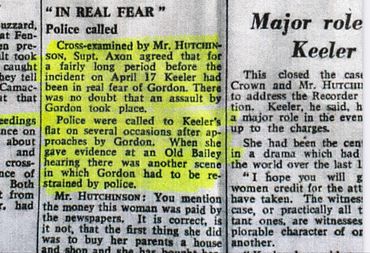
The heart of the injustice is that her lie was immaterial. Aloysius “Lucky” Gordon had a well‑documented history of violence against women, and according to police evidence at the time, a history of violence against my mother specifically.
That he assaulted her was never in dispute. There was:
1. Overwhelming medical evidence.
2. In court, Gordon himself admitted twice that he had hit her.
During her later trial in 1963, the very witnesses she had omitted actually took the stand and confirmed that the assault had taken place. The police acknowledged they knew Gordon had assaulted her. Even the prosecution barrister concealed nothing about his violence.
Because the assault itself was undisputed, Mum’s lie about who else was present changed nothing about Gordon’s guilt.
Legally, it should never have triggered a perjury conviction.
Mum did not lie out of malice.
She was heavily pressured not to involve the witnesses, who were married and terrified of the police and the damage exposure would do to their lives. Mum hid their presence to protect them—acting out of fear and duress, not an intent to pervert justice.
Instead of being treated as the victim of a violent stalker, she was subjected to a relentless campaign of public shaming by Parliament and the press.
It felt like the establishment used her minor legal infraction as an opportunity for retribution, turning their full weight on a young, vulnerable woman.
Trapped by a toxic media landscape, she was forced into an impossible corner where she felt she had no choice but to plead guilty. The result was the ultimate irony: the victim of violence served nine months in Holloway Prison, while her known abuser walked free.
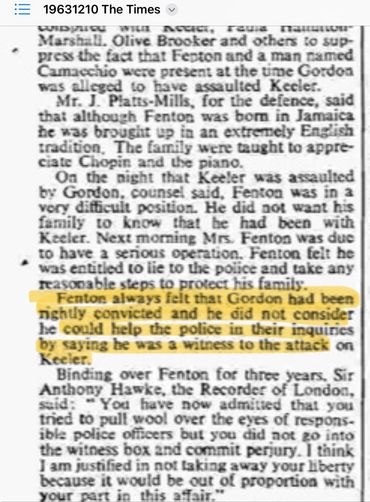
‘Christine was a victim of violence and sexual abuse who was sent to prison for lying about who was present when she was assaulted. Take a moment to think about that - she told the truth about being violently attacked, agreed to keep two men out of the publicity, and was the only one imprisoned from the events known as the ‘Profumo Affair'


Lucky Gordon had a criminal history that included attempted murder of a young woman.

Gordon would go on to stab another woman in the neck - in 1973.
Christine Keeler - had never been arrested, or even cautioned by the police - in her words:
“My name had never even been written in a policeman’s book”
The Events of That Night
The events of that night are well-documented through court testimony, witness statements, police reports, a doctor's examination, and the judge's summing up.
Christine, Fenton, Camacchio, and Paul left the upstairs flat to go dancing. Christine was the first to exit the front door, while the others were still making their way down (both Fenton and Camacchio testified to this in court).
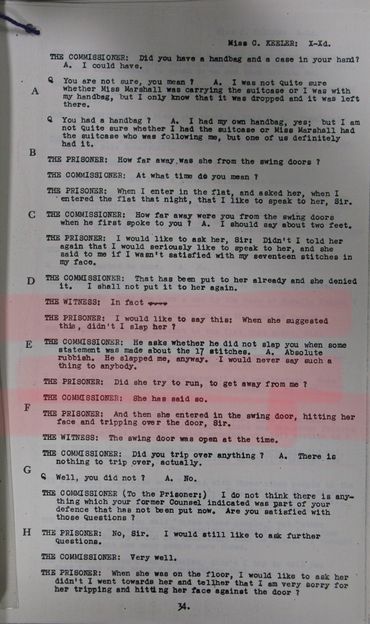
Gordon was waiting and confronted Christine. In court, Gordon stated, "Christine said she was pleased I got my face slashed." He then hit Christine (Gordon's testimony in court, which he repeated twice).
Gordon claimed that Christine ran back into the building, through the front door, and he followed her, continuing the assault (Christine's testimony, corroborated by both Fenton and Camacchio in the later court case).
Fenton was at the bottom of the stairs, Camacchio behind him, and Paula further up the stairs. They both testified that they were "frozen to the spot by the viciousness of the assault!" Gordon was punching and kicking Christine (Fenton and Camacchio's testimony).
Fenton intervened, grabbing Gordon's arm to stop the assault. He asked Gordon, "What do you think you are doing?" and Gordon quickly left (Fenton's testimony).
The police were called. Fenton and Camacchio pleaded with Christine not to involve them with the police, as one man was married, the other on probation, and they were both West Indian. They hid in the flat when the police arrived.
At 12:45 am, Dr. Francis Hughes examined Christine's injuries, which were multiple and consistent with an assault.
On the night of the assault, witnesses Rudolph “Truello” Fenton and Clarence Camacchio pressured Christine not to involve them. One was married, the other had already been in trouble with the police, and both were West Indian and afraid of the police.
Christine lied and did not tell the police they were there. Later, in court, she stated they were not present. This was deemed enough to charge her with perjury.
Christine Keeler was so hated in the eyes of the public that she was advised if she did not plead guilty, she would lose and go to prison for five years.
She took a deal to serve less time and to have some charges dropped—charges that would have allowed Lucky Gordon to sue her for wrongful arrest for a crime it was accepted he had committed.
The Unjust Treatment of Christine Keeler
Christine's denial of Fenton and Camacchio's presence was wholly immaterial to the fact that Gordon assaulted her. Even if she had mentioned their presence in court, the outcome for Gordon would have remained the same. Her lie was without malice; she was not lying about an innocent man. He had assaulted her that night.
"Imagine your house is robbed, the burglar is caught, witnesses testify, and the stolen items are found in the burglar's possession. In court, you, the victim, are asked, "Where were you at the time of the robbery?" and you say, "I went to the cinema." The defence then counters with, "We have proof that you were actually at a hotel with your lover!"
Imagine ending up in prison while the burglar goes free."
That is what happened to Christine Keeler.
In March 2022, case notes and an application were sent to the Criminal Cases Review Commission (CCRC), which is now reviewing whether Christine Keeler's case should be overturned. On Monday, 14 June 2021, these documents were sent to the Secretary of State for Justice.
They show that the criminal justice system let Christine down, perhaps even deliberately. We aim to demonstrate that her reputation was deliberately destroyed by the men around her, who have proven to be liars or Machiavellian in their motives.
update
2025
CCRC, using their discretion, decide that although there is merit to the case, they will not support our application to overturn her conviction.
May 8: Application for a Royal Pardon is submitted to the justice secretary buy the family of Christine Keeler.
Copyright © 2024 Seymour platt - All Rights Reserved.